You bought a full product foundation, not a code snippet. This page gives you the one idea that makes everything click, then a map of what's inside.
The one idea
You write ONE Python class. The framework mounts it on three surfaces at the same time:
from pydantic import BaseModel, Field
from apps.core.ctx import Ctx
from apps.core.registry import Endpoint, endpoint


@endpoint(slug="hello", description="Greet someone by name.")
class Hello(Endpoint):
    class Input(BaseModel):
        name: str = Field(default="world", max_length=200)

    class Output(BaseModel):
        greeting: str

    async def run(self, inp: Input, ctx: Ctx) -> Output:
        return self.Output(greeting=f"Hi, {inp.name}")
That single class is now three things at once. Here are the first two, both answering the class above, on the machine this page was written on:
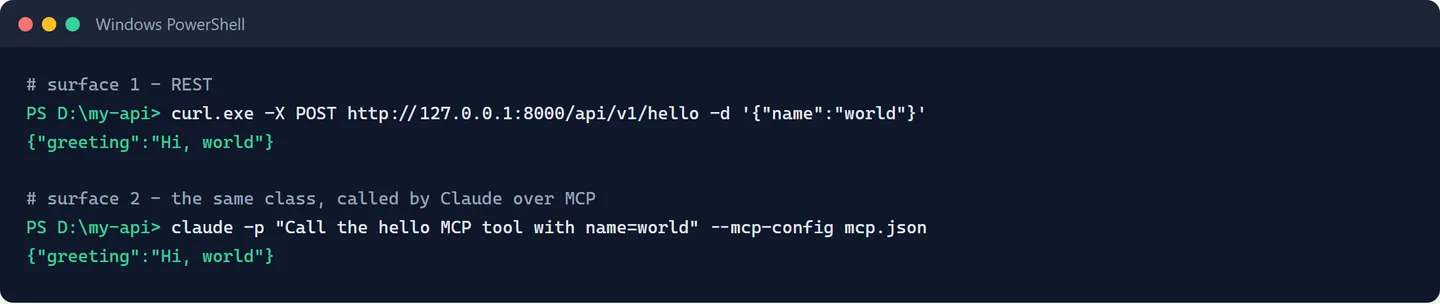
- A REST API endpoint at
POST /api/v1/hello. Typed JSON in, typed JSON out. - An MCP tool named
hellothat Claude, ChatGPT, or Cursor can call. - A documentation page at
/docs/hello/, generated from the same class:
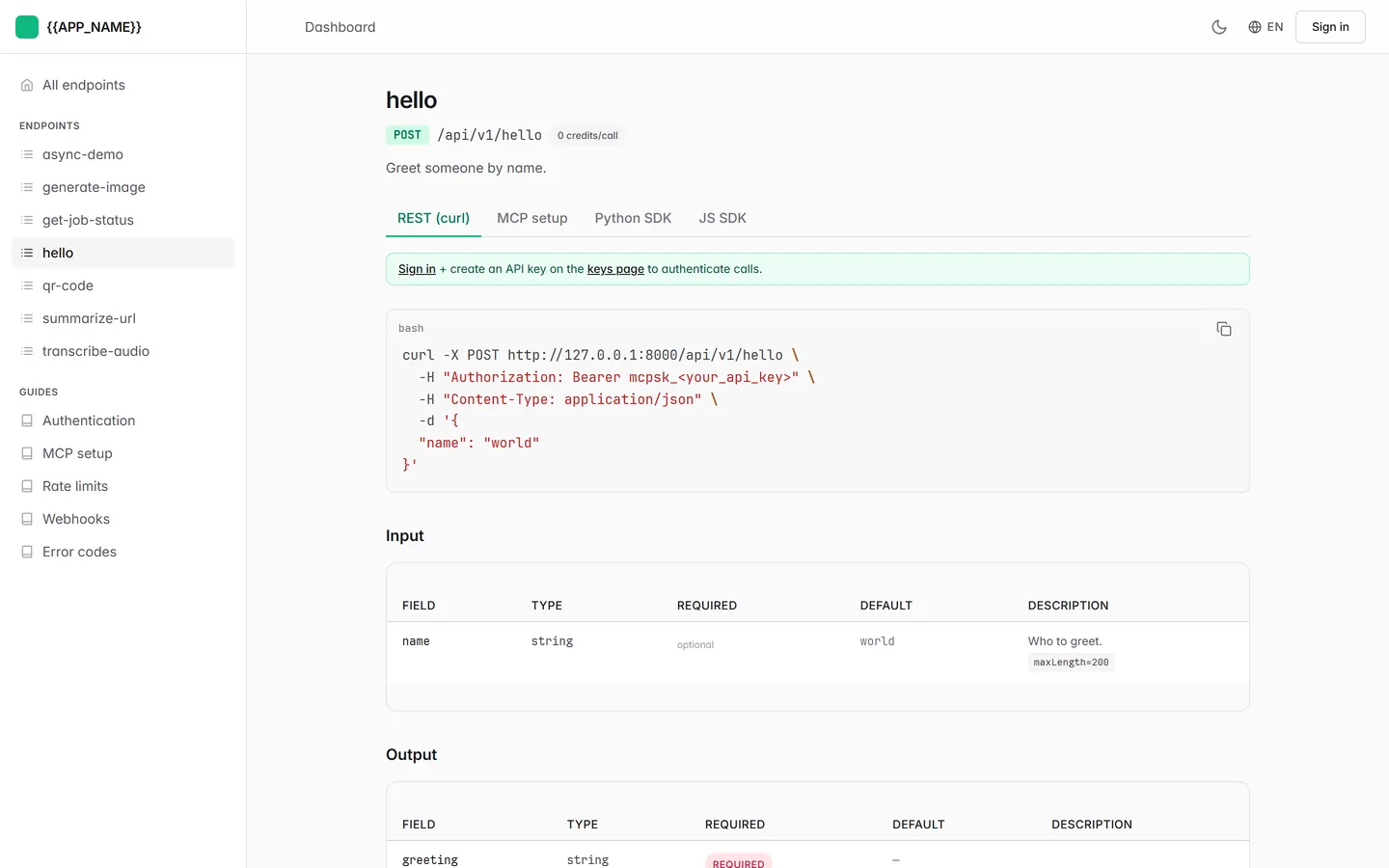
You never write the API plumbing, the MCP wiring, or the docs page. You write the class. That's the whole model.
What's already built around your class
- Auth: magic-link login (no passwords), API keys, and OAuth 2.1 so users can connect from Claude with one click.
- Billing: Stripe subscriptions and credit packs. Put
credits_cost=1on your endpoint and the framework charges per call, refunds on errors, and enforces per-plan rate limits. Works without Stripe too, credits alone. - User dashboard: your customers manage their API keys, see their usage, and top up credits at
/dashboard/. - Admin console: you manage users, plans, credits, call logs, errors, and background jobs at your own private admin URL.
- Operations: request logging, error tracking, scheduled tasks, async jobs, webhooks, health checks. The parts you only miss when they're not there.
The numbers, measured on the current code: 740 files, 1,088 passing tests, 20 Django apps, 30 reference docs in the repo.
What you can build
Anything shaped like "input in, result out, charge for it":
- a QR code generator (you'll build exactly this in Your First Project)
- a text summarizer or translator wrapping an LLM
- a web scraper or metadata extractor sold as an API
- a PDF, image, or audio processing service
- internal tools your team's AI agents can call over MCP
The proof it works
ToolerBox.com runs its paid API + MCP layer on this exact boilerplate, in production, with real customers. This is not a demo codebase.
How the docs are organized
Follow the groups in order the first time: Start Here (you are here), Setup (get it running), Your First Project (build a real endpoint in three short parts), Make It Yours, and Ship. After that, the 30 technical reference docs live in the repo's docs/ folder for when you need depth.